1.Introduction
PDV and PNRSV cause major economic losses in stone fruit crops, both in individual infections and, particularly harmfully, in mixed infections. Understanding the molecular mechanisms underlying the synergistic phenotype between the two viruses can help us understand the pathosystem and develop molecular tools to reduce crop damage.
One of the most useful tools for studying a virus is the design of functional and efficient infectious clones: they not only help us understand the host-virus interaction, but also allow us to investigate potential resistance mechanisms in crops. This work set out to generate infectious clones for the viruses associated with "Peach stunt" and evaluate the infectivity of different constructs, for both PDV and PNRSV.
2.Materials and Methods
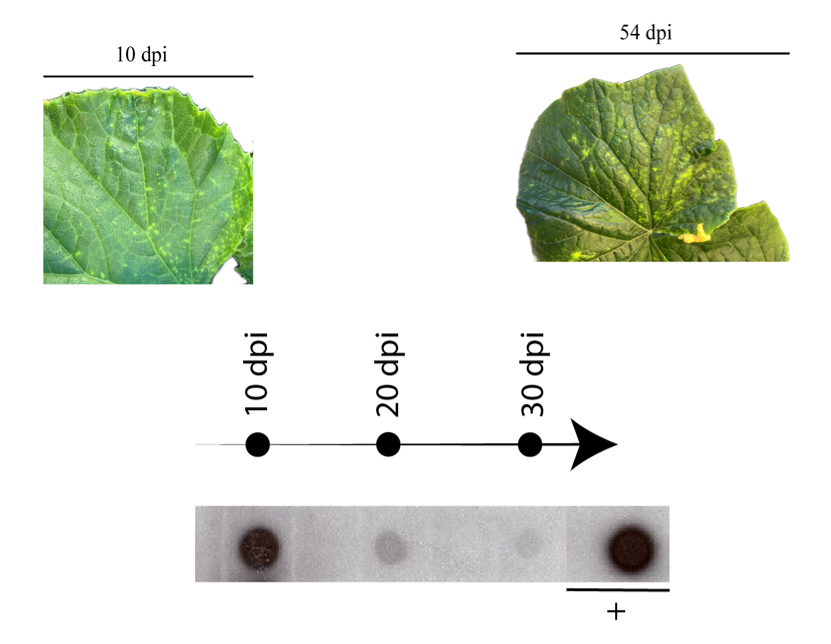
The genomic sequence of the 5' and 3' ends of PDV and the 5' end of PNRSV was determined using a RACE-based protocol (stem-loop oligo-dT). From these sequences, different infectious clone constructs were generated (tandem and tripartite, with and without ribozyme) through cloning, bacterial transformation and agroinfiltration. Infectivity was evaluated through mechanical inoculation and agroinfiltration in cucumber plants, confirming infection with Northern blot, Dot blot and RT-PCR, and monitoring viral load and symptomatology over time.
3.Results and Discussion
PNRSV constructs that included a cytosine (C) before the transcription start site were able to replicate, while those lacking it did not produce infection — an effect not observed for PDV. Each virus, moreover, required a different construct strategy: PDV worked as a tripartite construct without a ribozyme, while PNRSV worked both in tandem and tripartite form, both with a ribozyme.
Throughout PDV infection, an inverse correlation was observed between viral load and symptomatology: higher load with mild symptoms at 10 days post-inoculation (dpi), and lower load with more intense chlorosis at 30 dpi — suggesting that viral genotype and silencing-suppression efficiency matter more than raw virus accumulation. Mechanical inoculation also produced a notably higher infection efficiency than agroinfiltration.
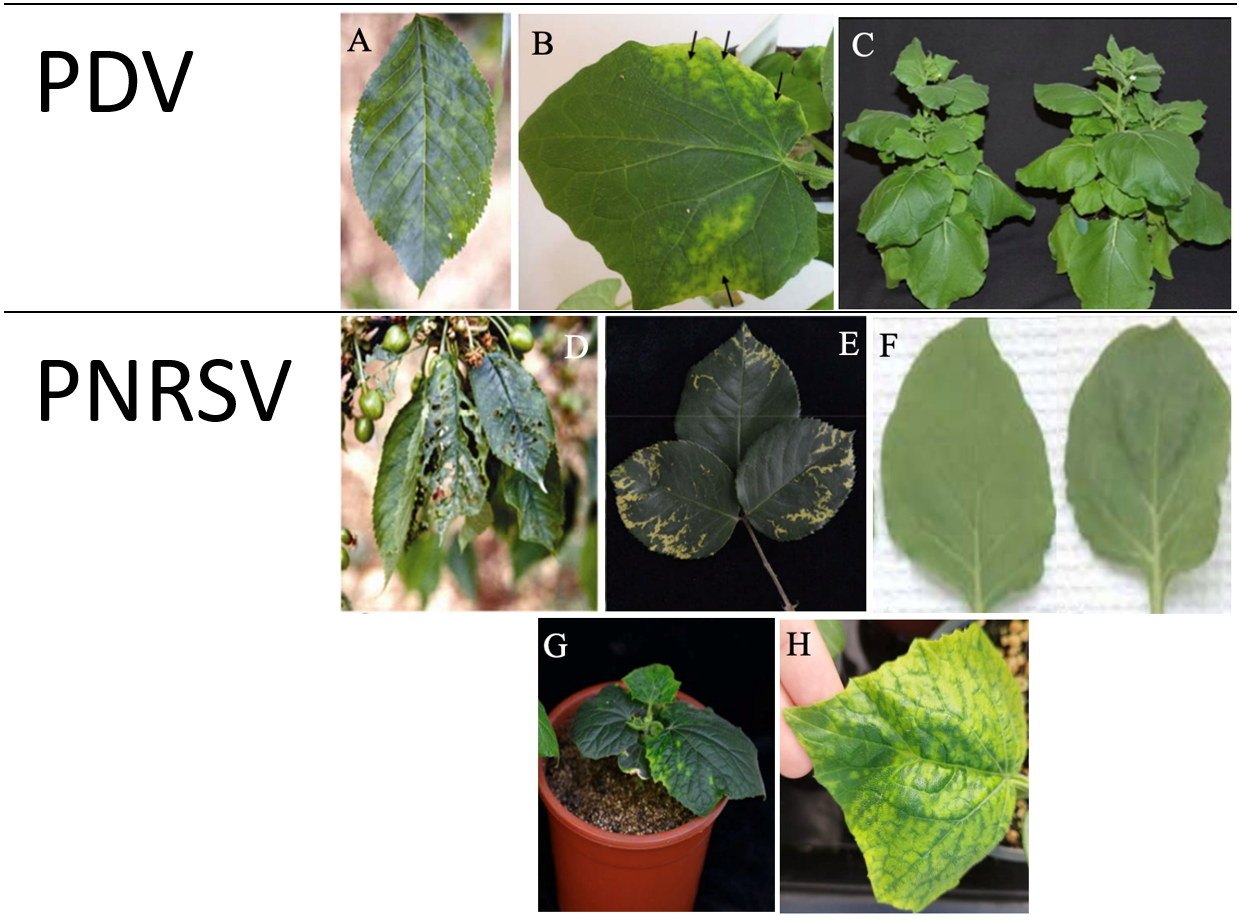
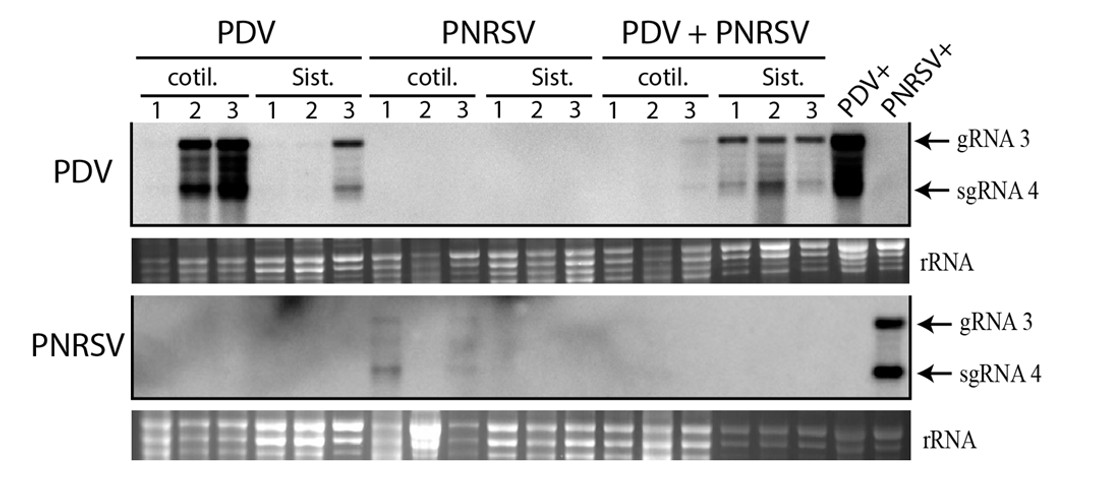
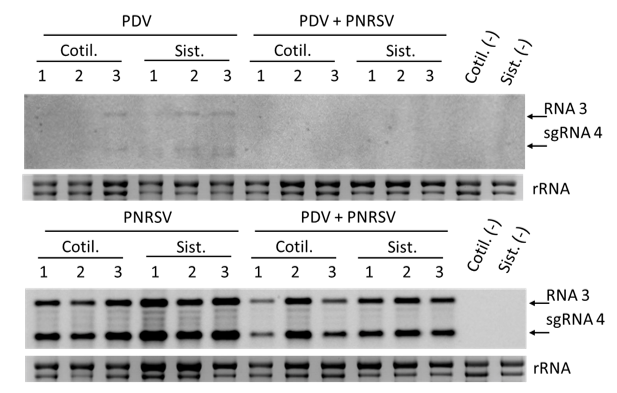
In co-infection assays, the prevalence of PDV or PNRSV varied depending on the inoculum source used, pointing to relative concentration — not just viral identity — as a determining factor in mixed infections. Unlike what has been observed in almond and peach, the mixed infection in cucumber did not reproduce the expected synergism, suggesting a host-specific component to this interaction.
4.Conclusions and Future Directions
Key contributions
- A nucleotide critical for PNRSV replication: the presence of a cytosine before the transcription start site proved essential, raising an open question about its biological role.
- Each virus required a different construct strategy, showing that there's no one-size-fits-all recipe for designing infectious clones.
- Viral load alone doesn't explain symptom severity, nor is the inoculation method a minor protocol detail.
- The synergism documented in stone fruit trees was not reproduced in the model host, motivating the search for a more suitable experimental system in future work.